History is a part of a pre-school curriculum that is easy to gloss over. But it is all around us in the stories we tell. With a little bit of intention in how we approach these stories, a young child can begin to grasp historical ideas.
Learning about history begins with understanding time. These are abstract concepts that develop during a child’s early years. With pre-schoolers, we talk about time with clear context, emphasizing vocabulary like “before,” “after,” “this morning,” “yesterday afternoon” or “next week.” We discuss the calendar in our circle time, where we also note the passing of months, seasons and holidays.
Similarly, we don’t directly teach history to preschoolers. Rather we repeat stories that lay the foundations for future years. But this isn’t something that we’ve invented as a curriculum. Maria Montessori herself taught history through stories. While that curriculum is typically associated with Elementary ages, the idea that children learn through stories is a practical one for all ages. The things we think about are based on our life experience, our own personal history. The most tangible story for a child is the one of their own life.
To Dr Montessori, history was a story that unfolded through time, and with it was created all of our intellect. Today, elementary-age Montessori curricula includes “Great Stories” about the creation of Numbers, Letters and Humans. This is part of our Cosmic education, which can include explorations of Nature and Humanity, trying to let the child develop a sense of their place in the world.
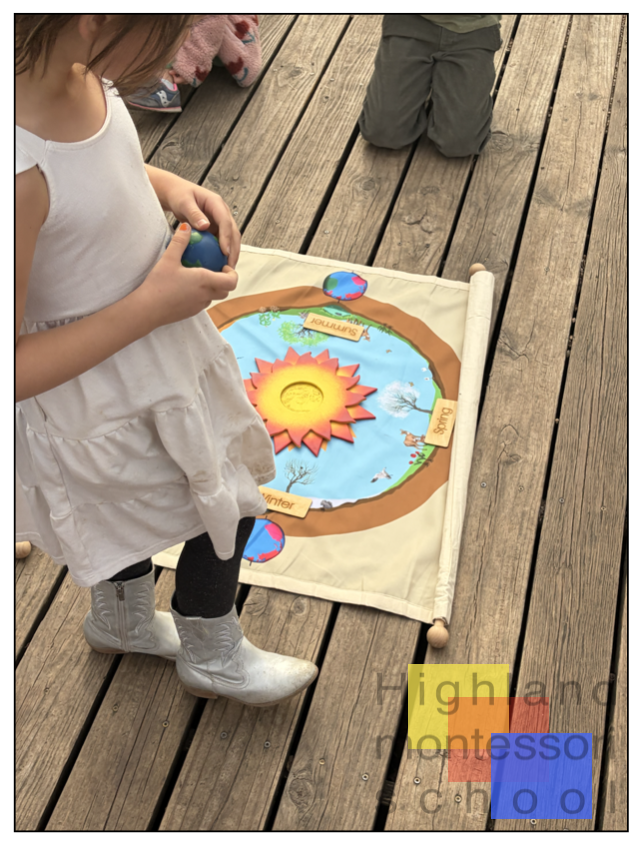
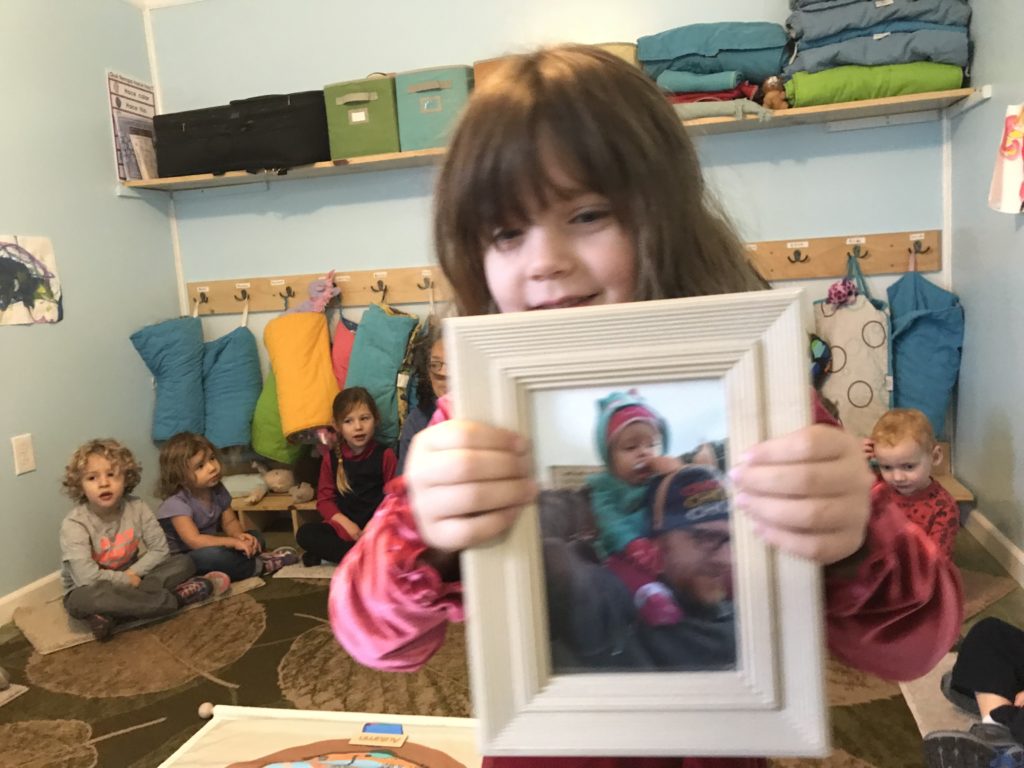
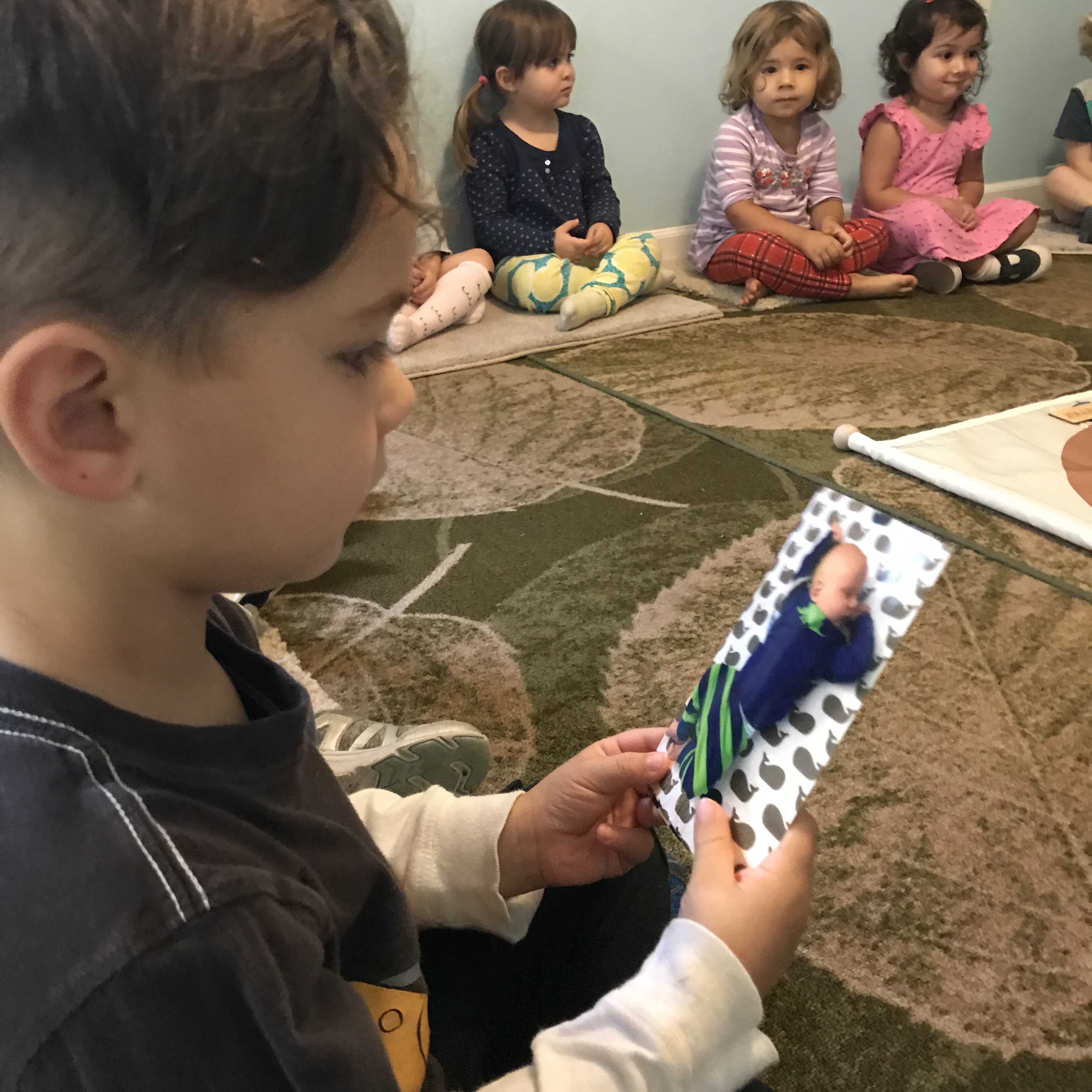
Last month we completed a 4-year-old’s Birthday Circle, and the week prior that of a 5-year-old. Birthdays are a special occasion for a young child, when they are the center of attention. As a part of our Birthday celebrations, the child’s parents bring in photos from each year of their life. We explain to the class how the earth used to go around the sun without them, until Mom and Dad had this baby, at which point they show us a baby picture. The child then “walks around the sun” (carrying a model of the Earth, see photo) while we receive the seasons as they walk. This represents a year of their life, at which point we look at a picture from when they were one year old. We repeat this for each year up to present–effectively, a walking timeline of their life, with pictures.
History, to Dr Montessori, is part of a child’s Cosmic education. In To Educate the Human Potential, she stated her goal to “give the child a vision of the whole universe… and the story of humanity’s labor.” Through understanding history, the young child begins to understand their world and their place in it. With that, they gain a sense of responsibility to their surroundings.
In the fall, when we were writing about the Holiday Season, we pointed out that for a child who just turned 4, six weeks is nearly 3% of their lifetime. To a parent who is 34, that same six weeks is one-third of 1% of their lifetime. That is quite a disparity, but it shows just how time is different to young children.
A child’s history is short, it’s fleeting, and we have a lot of careful work to do to build their strong foundation.